Buyer’s guide
6 Things I Wish I'd Known Before Buying a Red Light Therapy Mat
Most red light mats look identical in product photos. The differences that matter are buried in the spec sheet. Here’s what to check before you buy.

Search for a red light therapy mat and you’ll get hundreds of results. Most show the same glowing red pad, the same five-star badges and the same promises. Prices range from under $200 to well over $1,000.
It’s hard to tell them apart until the box arrives. Then you find out the mat is shorter than you are, the near-infrared setting looks like it’s broken, or nobody can tell you where it was made.
So before you buy any mat, ours included, here are the six things worth checking.
1Check the exact wavelengths, not just “red light”
“Red light” is a loose term. On the spec sheet you want an exact wavelength in nanometers (nm). Two of the most widely used wavelengths in red light research sit around 660nm, which is visible red, and 850nm, which is near-infrared and just past what your eyes can see.
The two behave differently. Near-infrared light travels deeper into tissue than visible red, which is why many people want both in one device, with the option to run each on its own or together. If a listing says “red LEDs” and gives no numbers, treat that as a warning sign.
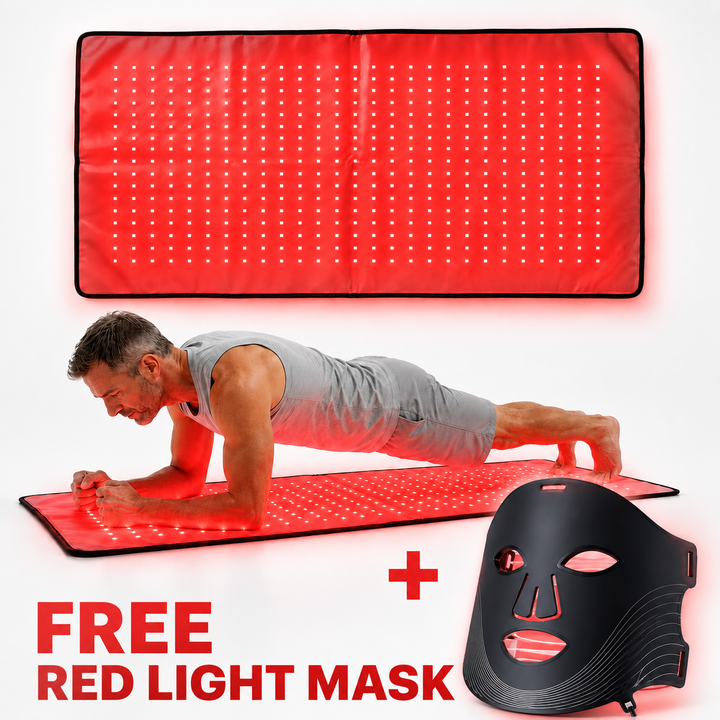
Primalon: 660nm red + 850nm near-infrared LEDs, with Red, NIR and Combo modes.
2LED count only matters if the LEDs cover the whole mat

A big LED number is easy to print on a box. What matters is how those LEDs are spread out. Clusters of lights with gaps between them give you bright spots and dead zones. A dense, even layout means your back, hips and legs all get a similar session.
Ask two questions: how many LEDs are there, and do they run across the full surface or only the middle section?
Primalon: 3,960 LEDs evenly arranged across the full surface of the mat.
3Measure yourself before you compare prices

Small pads and panels mean moving the device every few minutes: your back, then your legs, then your shoulders. It’s the kind of routine that’s easy to skip.
A full-body mat lets you lie down once and cover most of your body in a single session. Before you buy, compare the mat’s length with your height and check that it’s wide enough for your shoulders.
I was skeptical, but the mat is actually comfortable. The size is legit – covers more than I expected. I’m using it mostly after gym days and it feels like a good reset.
Mike D., Nashville, TN · Primalon customer
Primalon: 71″ × 31″ surface, designed for head-to-toe sessions without repositioning.
4Near-infrared looks almost “off,” and the mat gets warm. Both are normal.
auto-off
Product listings rarely mention this. 850nm near-infrared sits mostly outside what the human eye can see, so in NIR-only mode the LEDs glow faintly or look barely on. The light is still there.
The mat also warms up, more at higher levels and in longer sessions. That’s why adjustable intensity matters. Start at Level 1 or 2 for your first few sessions and move up only if it stays comfortable. A timer with automatic shutoff means you can relax without watching the clock.
I’m using it for soreness and general stiffness (desk job + weekend hoops). I like having levels because some days I want it low and calm, other days I crank it a bit. It’s easy to stick with.
Ethan B., Seattle, WA · Primalon customer
Primalon: 5 intensity levels, Red / NIR / Combo modes, and a 10–90 minute timer with automatic shutoff.
5Ask for safety paperwork you can check yourself


You’ll lie on this device several times a week, so it should come with more than a badge graphic. Look for documents you can verify: an FDA establishment registration number for the factory, FCC testing for the electronics, and RoHS compliance for restricted substances.
One detail many buyers miss: “made in an FDA-registered facility” describes where a product is manufactured. It doesn’t mean the device itself is FDA-cleared or FDA-approved, so be cautious of listings that blur the two.
Primalon: Manufactured in an FDA-registered facility (Reg. #3035878914), FCC compliant and RoHS compliant.
6Work out the cost per session, then read the return policy
Full-body red light sessions at spas and clinics typically cost $50 to $200 each. Three sessions a week at the low end comes to about $600 a month.
A home mat is a one-time cost, and you can use it whenever it suits you. Before you buy, check three things: what shipping costs and how long it takes, how many days you have to return it, and what the warranty covers.
Primalon: Free tracked US shipping (most orders arrive in 4–10 business days), 30-day free returns on eligible unused products, and a 1-year warranty.
The short version: your 6-point checklist
| What to check | Primalon |
|---|---|
| Exact wavelengths listed | 660nm + 850nm |
| LEDs across the full surface | 3,960 LEDs |
| Long enough for your body | 71″ × 31″ |
| Adjustable intensity and timer | 5 levels, 10–90 min |
| Safety documents you can verify | FDA-registered facility, FCC, RoHS |
| Clear shipping, returns and warranty | Free shipping, 30-day returns, 1-year warranty |
Limited offer: free mask with your mat
Claim 55% Off Today →Click the button above to claim your discount and free mask.
You’ll go to the Primalon offer page and see your total before you pay.